That smoke blotting out the sun yesterday afternoon? Once night came on and the winds shifted The entire valley I was camped in, hemmed in on the west by the ragged escarpments of the Ritter Range, filled with smoke. It was so thick I couldn’t breathe well without something covering my face, and even then my breaths were short and shallow. The discomfort and uneasiness of it kept me from sleeping. Or it would have, if I already weren’t wide awake because, I think, of the wake of adrenaline left after the wild and crazy climb up the mountain face adjacent to Whitebark Pass, the face of Peak 3258 (on the Mt Ritter quad). I learned long ago to avoid spikes in adrenaline too close to bedtime, in dance actually, when I must be careful to avoid a certain kind of high energy, high flying, wild, and unpredictable dance late in the night, or else sleep would become predictably impossible. Climbing Peak 3258 was a different kind of encounter, one in which the task of survival is more deliberative and less reflexive. I want to say more real, though the question of survival is one of the primary questions of the dance form I study (Contact Improvisation, for those of you who don’t know). I suppose the nature of climbing the face of Peak 3258 is that the consequences of not surviving are both much closer and are more certain. In dance, well, we allow the words we use to mean so much more.
So a relatively sleepless night, filled with smoke and anxiety, and even though I eventually did fall asleep I was up with predawn wind as it viciously whipped my tent. (I was literally a calm center in the storm as my tent threatened to blow down around me as I meditated in it).
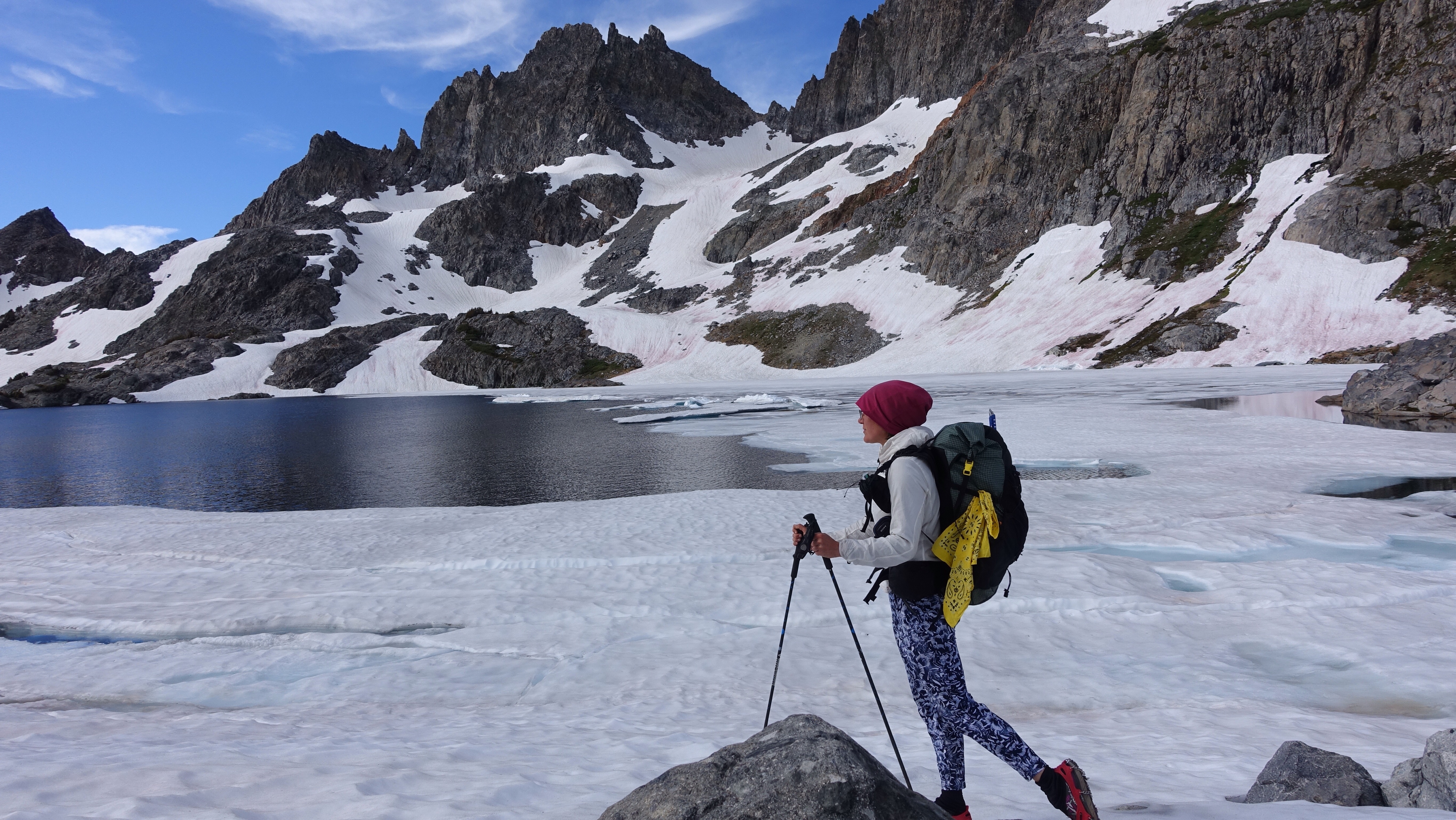
As I hiked down out of the meadowlands below Mt Ritter, I could feel tiredness weigh down my bones, like a having a skeleton made of granite, grinding away on itself as it tumbles down the hillside. I had a pass and a lot of lakes to visit today, held together by yet more complex terrain. First lake: Ediza. I ran into a group of backpackers there, the first people I’d seen since the surprise men while I was swimming at Blue Lake two days ago. The backpackers had also struggled with smoke last night and were planning to quit their trip early, which made a kind of sense. I wished them luck and continued on. From Ediza Lake I climbed up through snow fields and among large granite humps to Iceberg Lake. In a normal year, I’m told, Iceberg Lake has a few patches of snow on its north side that don’t melt because it sits in such a deep bowl. This year the deep sides of the bowl held more snow than rock on all sides, and I had a long traverse on its icy walls. My microspikes worked hard, slipping slightly around my shoe because the slope was so severe, and it was, again, an act of survival. At the bottom of the treacherous fields was only a lake so blue it was darker than black underneath a blanket of snow. A bad slip, well. Better not slip.
After the traverse, I climbed the headwall out of Iceberg Lake’s basin and arrived at Cecile Lake, also snow and ice clad. It all went like this: contour around, spikes on, spikes off, spikes on, don’t slip into that ice-filled and bottomless tank, and then I was at a class 3 downclimb through a slot in a the massive granite wall on top of which Cecile is perched. It was nice to encounter an obstacle which felt relatively tame after the tensions of everything else.


After, a nice contour around picturesque Minaret Lake on a brief trail, and then off again into the underbrush, contouring around a valley headwall to ascend slowly up to Nancy Pass. The climb was uneventful. Restful in that way, even if I still need to stop for extra breaths every few steps. Some steep hemlock forest slopes followed by talus, then more forest, then more talus, with a couple of small snow fields thrown in because of course. And then I was there at the top, examining the small plaque someone had installed to commemorate eight year old Nancy who climbed the pass and then died two years later, back in the sixties. I ate my lunch with her spirit, if it is there as the plaque said it was, which seems a stunningly beautiful if lonely place to linger.

The descent down the south side was irritating. It was the first intense scree chute I’ve been inside of on this hike so far, and I suppose I find that impressive. Mountains in Washington State, my home, are often navigated by tedious scree chutes because they offer the only passage in an otherwise improbably landscape. That it takes six days for one to appear here on the Sierra High Route is, if nothing else, a kindness. Still, it was quick enough to negotiate, and I jumped out of it onto steep sage brush slopes to the right as soon as I could. Once down to the meadow floor, I joined trails for seven hot and dusty miles to Red’s Meadow Pack Station. The tedium of trail miles were wholly redeemed by the olfactory pleasures of waking through an arid pine (and others) forest on a hot day, when the sun liberates a warm honeyed scent from the bark of the trees and I could almost imagine being a fat, contented fly making lazy circles in the soft breeze.

I am camped at Red’s Meadow now, a hub just up the mountains from Mammoth Lakes for tourists visiting Devils Postpile and John Muir Trail hikers. I had a blissful, $5-for-five-minutes hot shower–hallelujah!–and washed my clothes while eating dinner in my rain suit. I picked up my first resupply packages here: food, maps, and heart to go the next seven days until I reach Parcher’s Resort up the mountains from Bishop. Well, maybe not heart. Maybe I have to get that somewhere else.


Leave a Reply