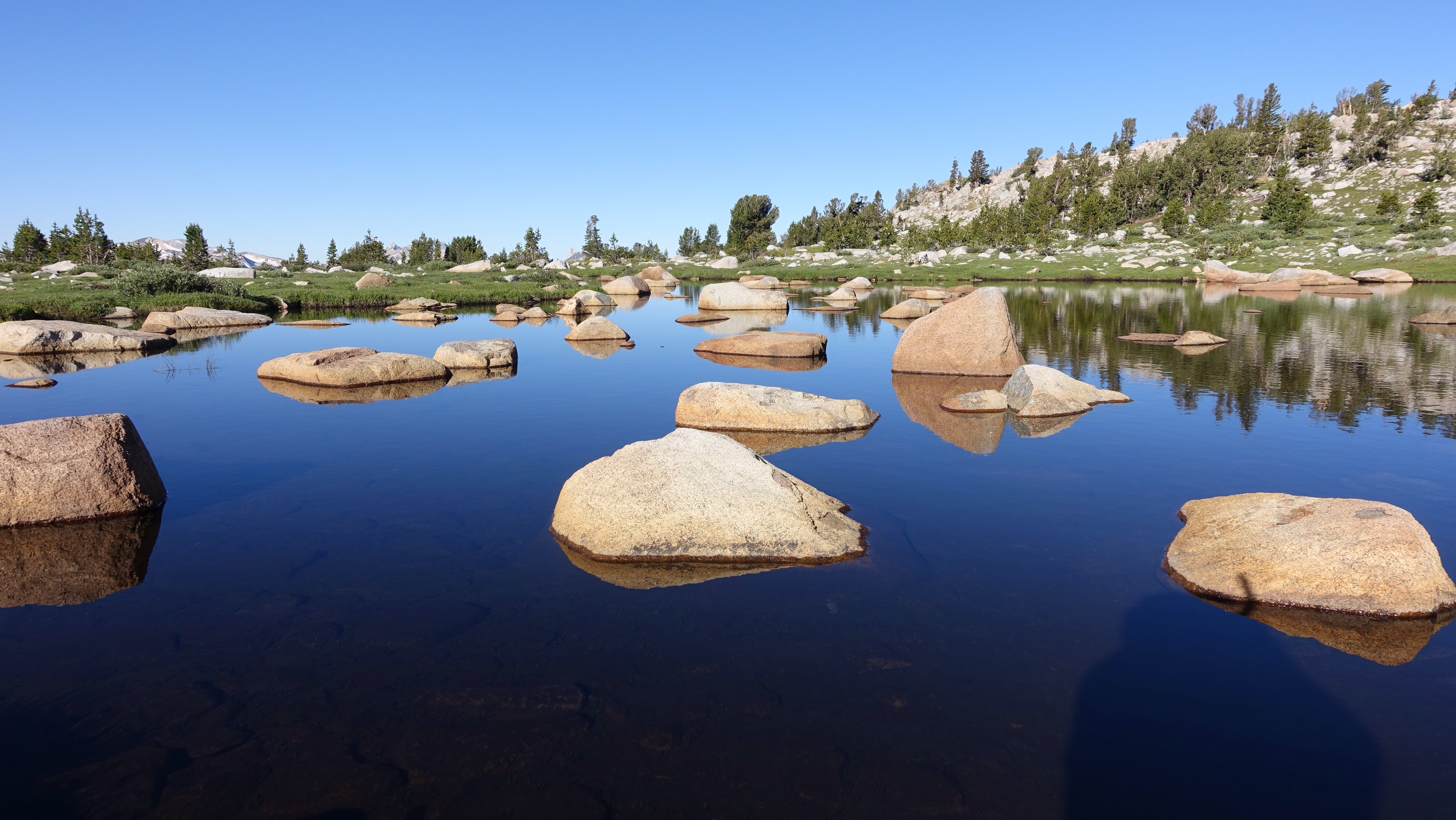

Morning, rise to the sound of scuffling in camp, scare the mystery away, meditate, pack, and climb upward through alternating broken red shale and patches of snow, slick and hard and glossy from the cold night before. My micro spikes are working hard, and I don’t slip, even when the traverses are steep.
Shortly I cross Mine Shaft Pass and enter Yosemite National Park, then descend more broken red rock and shiny snow to the Great Sierra Mine, active in the late 1800s. A few rusted machine parts, a falling-down stone house, and a terrifying hole in the ground are all that remain. My feet throbbed to be near the mine, that horrible hole. Timmy fell down the well kept running through my mind as I stood back from the edge and leaned over to see into the black pit. I picked up a rock and threw it in, thinking I would hear it clatter down for an eternity, like the hole was the entrance to the Mines of Moria (Lord of the Rings). But it splashed into water, and I was both more horrified and also perplexed: how did the miners in the 1800s, without pumps (true?), keep the water out of their horrible holes?
The mine pit water hole.


From the visceral ache of the Great Sierra Mine pit, it was a galumphing downhill through meadows, past lakes and ample mosquitoes to swat, and eventually a trail which took me to Tioga Road, the only road that crosses the mountains east to west in Yosemite National Park, and the only one that crosses the mountains that I’ll encounter on this entire trip. The particular music of cars breaking wind, of tires spinning on asphalt, filled the air as I darted across, feeling like a bit more like wildlife at that moment trying not to end up flattened on a ribbon of pavement, sandwiched between dense stands of Lodgepole pines. Right after, I had a quick river ford (knee deep but easy enough to do barefoot and keep my shoes dry) and then some more easy trail to Tuolumne Meadows Lodge, a kind of commercial encampment just off the highway. They have guest lodging in these little white cabin-tents, and people! Lots of people, needless to say. The man inside the lodge store let me charge some electronics and while I waited I used the sink in the bathrooms to wash my face, I ate an ice cream sandwich, I called Dan (beloved husband) on the pay phonem I ate a second ice cream sandwich. The brief stop there was functional and productive, if not exactly restful. As soon as my things were charged, I left, joining the Pacific Crest Trail/John Muir Trail briefly south among many more people before turning off on another trail.


I hiked the PCT in 2005, and I don’t remember stopping at Tuolumne Lodge back then (so much of that hike has receded into the unstructured fog of memory), though I’m sure I would have certainly resupplied there. Over these last couple days, my thoughts are often returning to that hike and time, in part because I’m back in the same mountains as then, albeit on a very different kind of hike. I am a different person, an accumulation of many more stories collected over twelve years. Maybe the mountains are different too. Twelve years is a long time and not a long time at all. Time has no fixed meaning. We all just endure its slippery shifts as we change perspective.
Speaking of changing perspective, I will say that a marked difference between then and now is that I don’t recall having so many pains in 2005. My feet, my ankles, my hips, my neck, all achy or angry or sad or something. I’ve been managing a set of recurring sprains for the last year in my right ankle, and they jammed up while hiking on the trail to Tuolumne Meadows. I must pay very close and precise attention to each footfall on talus and rock cross country, and of course it is the sleepiness of trail hiking that causes me trouble. I suppose this is not particularly surprising.
After Tuolumne Meadows, I was facing many miles of trail, a compromise the route has to make to get around a series of mountains whose dramatic ridges require more technical tools than the typical scrambler has at their disposal. Miles of trail climbed up to Tuolumne Pass, where I encountered yet many more backpackers out to enjoy the park. Before long I arrived at the jarring sight of Vogelsang High Sierra Camp, one of a network of hut-to-hut hiking stops where guests are fed, and some are even packed in on mules. But because the Sierras received so much snow this year, none of the High Sierra Camps will be opened at all. Framing laid on the ground, windows were boarded up. The place looked abandoned and trashy, an incongruence in this beautiful landscape. I climbed miles of trail further still, past more people and past Vogelsang Lake, nestled into a cirque below Vogelsang peak, miles of trail up and over Vogelsang pass (names come in clusters), and then dropped miles of trail down past timber line into a pleasant Lodgepole forest along Lewis Creek. I’ve been on trail for almost the entire day, since a little before Tuolumne Meadows, and already I’m hungry for the unknowns and dynamism of cross-country travel.

As I made my dinner and watched night creep up between the trees and listened to the chattering small creek nearby and the hiss of my simmering pot, I passed a small stone from one bare foot to other using my toes. I’m trying to proactively rehab my feet on this trip, keep them strong and healthy. They are such tiny pieces of real estate, to handle so much. The major bone of the heel is called the talus, and as I hop from rock to rock across talus fields, at same time the enormously complex landscape of the ankle talus is sensing, navigating, adapting. Talus on talus. Dynamic structure on textured land.
Putting on my backpack. It happens many times every day, so sometimes you gotta change it up.
Leave a Reply