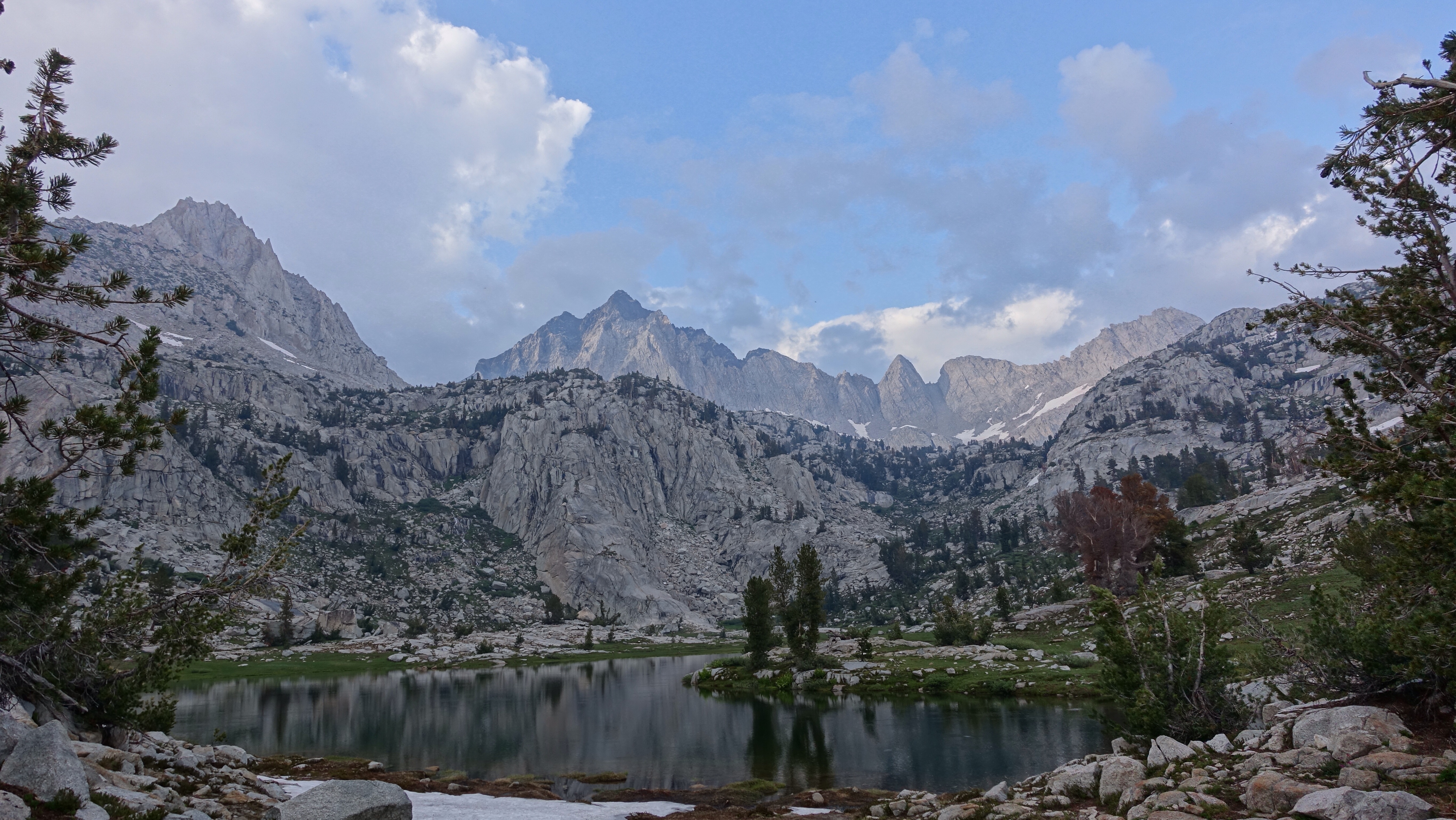
Mornings are a sweet time in the mountains. The air is fragrant with optimism, birds sing to the gentle sun, and I don’t know yet what my day will feel like. It’s unwritten. It’s unknown.
What I did know when I woke up next to the placid surface of Deer Lake is that I would be on trails for about the first nine miles of the day. A light use trail (this is a way of describing an emergent path created by feet walking, as opposed to a trail planned and built by a trail crew) led from Deer Lakes’ serene little hamlet over the Sierra Crest, west to east in a zig, then a quarter mile later back east to west in zag, before descending to Duck Lake. I picked up a real trail there along the shores of Duck luck, which descended to join the Pacific Crest Trail (and John Muir Trail–they sometimes share the footpath in the Sierra), on which I walked for six long miles, encountering other hikers every 15 minutes or so. Most were JMT hikers, but there were a few PCT hikers who skipped the Sierras when they would have gone through in June due to the high snow year and only now are returning to finish up this section. Lots of PCT hikers seem to hike the trail this way these days, employing a strategy known as flip-flopping (not the same as the political version of flip-flopping). Hike a part, go somewhere else, hike another part, piece by piece until by the end of the season you’ve completed the trail.
I also ran into another Sierra High Route hiker today, the sixth party of SHR hikers headed northbound since I started eight days ago. I’ve never encountered more than one party per day, but more days than not there has been a passing. If we meet on one of the remote, trailless sections, we immediately know one another as fellow SHR hikers. If we pass on a trail and eye one another’s ice axes, inquiries are made and kinship established. No one else out here seems to be carrying ice axes. Indeed, at Red’s Meadow, I was mocked by some JMT hikers for having one when they thought I was another JMT hiker.
I met the SHR hiker today long after I had left all the trails and begun the hearty ascent of a few thousand feet from Tully’s Hole up to Shout-Of-Relief Pass (11400 ft). These off-trail ascents are steep, and my left ankle’s wee tendon was complaining as I hefted myself up rocks, slabs, and severe inclines dotted with small boulders and pines. I had just finished such a climb up to Cotton Lake and saw a figure coming toward me, who I knew must be an SHR hiker because trails were long behind me (or long ahead). I was pleased to discover another solo woman who is doing a section of the route. In all the other parties of SHR hikers I’ve met, only one other person was female and she was with a partner. Not that it matters really, but I do notice there aren’t many women out here, and even fewer who fly solo. We didn’t chat for long–the mosquitoes were horrendous and we both had places to be–but I did get some helpful information about her experience on a pass I’ll be crossing three days from now that, with all the lingering snow this year, has had me a bit worried. Snow-Tongue, they call it. What a name in a year like this one.
After waving goodbye, I continued the climb up to the pass, over rocky outcroppings, up steep grass slopes, across soft and slippery snow patches streaked with red (‘watermelon snow’ is how I’ve always known the red streaks that appear on consolidated snow fields in summer, and my understanding is that it’s a kind of fungal growth). I was in a bit of a hurry, despite having decided many days ago I wished to avoid being in a hurry on this trip, because to set up my days right for the upcoming passes between here and my next resupply stop, it would be best if I could make it to Laurel Lake tonight, nine trail miles and six cross country miles over two passes away. If the passes were straightforward to navigate and relatively free of obstacles, it wouldn’t be a problem to cover this mileage, but of course I didn’t know what they would be like until I was with them in person. So I was hurrying, not stopping to rest or eat or drink water much, and then the clouds began to flock together, thickening and darkening the sky to the west. Afternoon thunder storms are a regular occurrence in the Sierra during summer, and they can often be vicious, though brief. I needed to be off the ridge containing Shout-Of-Relief Pass before they unleashed their gathering energy, in case they happened to do it right overhead. So now I was hurrying to crest the pass before the weather came, and I was thirsty and I was hungry and I was climbing up up up. In general I rather dislike physically onerous ascents under time or weather pressures, and yet they do seem unavoidable from time to time. I suppose I could have stopped next to a slight trickle of snowmelt in the next flattish place and called it a day, but I didn’t.
As the dark clouds moiled about over nearby peaks, I labored upward and finally, with all the sludgy spirit of a very tired human, made it to the top of the pass. Taking no time to revel in the fact, I sped down the other side, dropping a quick 600 feet to Rosy Finch Lake. Once on the lake shore, I stopped finally for a snack and some water, and to see whether the clouds would go for it or not. Watching a mass of dark cloud shift one way and another, grow, change shape, etc, is like watching a person who has a sneeze coming. In either case the contortions may not come to fruition, but as a viewer there is an expectant pause, a held breath, waiting for the denouement that is being prepared. No storm broke as I sat on a rock eating triscuits and almond butter, watching ice floes slowly approach as the wind blew them across the lake. A few scattered drops fell, but then the clouds seem to blow off elsewhere and take their threatened sneeze with them. I shouldered my pack and made the next ascent, 400 feet up to Bighorn Pass (11250 ft). A stout climb, with big steps up making my ankle tendon cry out for mercy, and before long I was detouring a snow field and descending the other side, down down down to Laurel Lake looking diminutive some 900 feet below the pass. I arrived exhausted from racing the storm that didn’t come, and though it was early, a quarter after five, I decided to give it a rest and stop for the day. As I was setting up my tent, the edge of the storm finally made an appearance, and though there was no lightning I could see and the thunder sounded far away, rain began to make twinkles on the surface of the lake as the fish jumped for mosquitoes. The sound of rain pattered on my tent. I donned my rain gear and a headnet because these here are the worst mosquitoes I’ve seen all trip, and I sat out in the weather and cooked my dinner. Mac and cheese and tuna, in case you were wondering, and itt was delicious and warm, and the ripples on the lake from the jumping fish met the tiny flashes of dropping water from the rain, and the mosquitoes whined at my face but couldn’t bite me, and Red and White Mountain loomed above the lake, framed perfectly by the steep walls of the valley and the richly textured sky, everything misted in the atmospheric storm, and I thought fuck yeah.


Leave a Reply